

The financial technology (fintech) industry is flexible, and new entrants quickly adapt to changes. One truth, however, remains unchanged. Building financial and digital services from the ground up is resource intensive and time consuming. As a result, firms are always looking for opportunities to outsource white label (private label) financial and digital services.
White Label Fintech Solutions provide firms with the flexibility to offer financial and digital services under their respective brand names. Consequently, the firm benefits from increased scope to provide financial services to customers. Typically, a white label financial services solution is made up of an integrated set of services, back end and front end platforms (including web and mobile applications), and an administration portal.
The goal of a typical business is to provide a financial service; however, the goal of a business focused on providing digital services is to integrate as many complementary digital and financial services as possible.
What Are White Label Fintech Solutions?
A white label fintech solution allows companies to license technology solutions and offer them under their own brands.
Alternatively, companies can license a technology solution and brand it themselves. This offers a number of benefits including cost savings and a reduction in time required to create and commercialize the technology.
An example white label fintech solution may include:
– A web and/or mobile platform
– Back-office administration panel
– Retail and/or user management
– Distribution management
– Payment and/or financial services
– Wallets and/or transactions
– Commissions
– Integrations
– Reporting
– and other miscellaneous services
The scope of a white label solution is largely defined by the technology and business constraints of the provider.
For example, IMOC Digital offers a white label solution that integrates an administrative and business management platform, mobile application, and web application with a range of digital services.
How Does a White Label Fintech Platform Work?
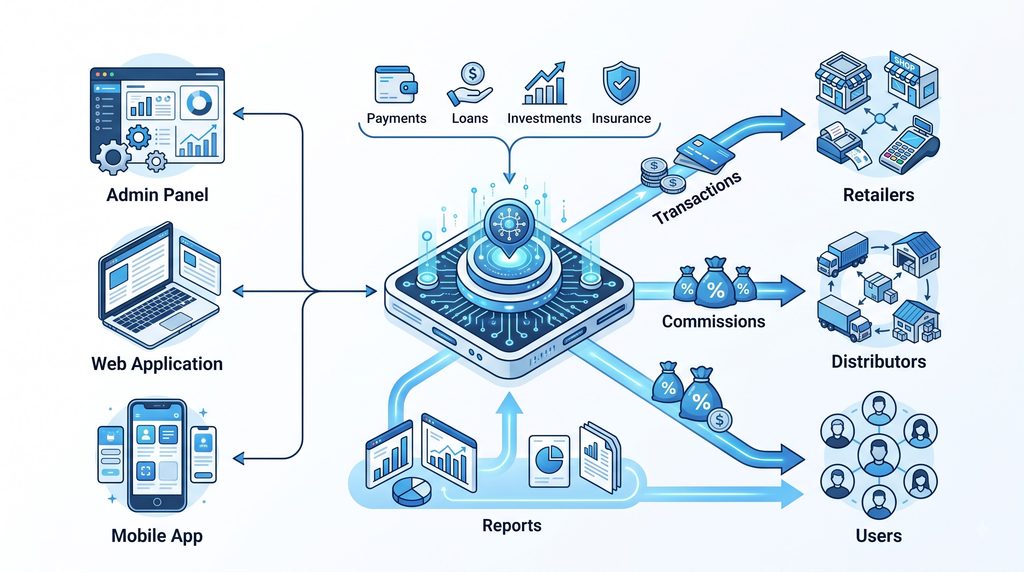
Understanding this model is not complicated.
A technology company provides the lower level functionality and integrations, and a business builds and runs customer-facing elements of the solution.
This model is made up of different components, which are described in detail below.
1. Defining the Business Model
The first component involves understanding the business’s ideas on the type and volume of offerings, as well as the customers using the platform.
The business may operate in any of the following segments: retail, distribution, financial services, payments, fintech and/or other digital services
2. Identifying Relevant Services
The business must identify the services relevant to its customers and operating in its selected segment.
These services may include financial, payment and/or other utility, business and/or travel services.
3. Customizing the Platform
The business must define the type and volume of users and how the workflows in the platform integrate with the business’s offering.
4. Defining the Business’s Brand
The business integrates the platform with customer facing elements, for example, a website and/or application.
5. Setting up the Back office
The back office integrates and provides single window access to the retailers and/or distributors, as well as transactions and commissions.
6. Starting and Expanding the Business
Once the above steps are completed, the business may launch its digital services offering and platform, as well as define the scope of services it wishes to offer in the market.
IMOC Digital’s implementation of this model is based on similar elements.
Why Do Businesses Use White Label Fintech Solutions?
Launching a fintech platform can be time-consuming and expensive because of the need for IT development and integrations, as well as the establishment of procedures for operations and services. Continuous upgrading of the platform is necessary.
Using a white label strategy, the time and cost required to establish a platform can be reduced.
Improved Speed of Business
The white label strategy provides a platform and allows services to be introduced faster.
White label solutions are relevant to a range of businesses including product and service distributors, fintech companies, and other businesses that want to quickly introduce their services to the market.
Build Under Your Own Brand
One of the main advantages of a white label solution is brand ownership from the customer’s perspective.
The platform can be designed around the business’s identity, helping customers interact with a consistent digital experience.
Multiple Services in One Ecosystem
Businesses can combine multiple supported services instead of sending customers or retailers to different platforms.
Depending on the configuration, a digital ecosystem may include financial services, payment solutions, recharge and bill payments, business services, and travel services.
IMOC Digital currently offers service categories covering banking and financial services, merchant and payment solutions, utilities, business services, travel, and additional digital services.
Centralized Business Management
A central admin panel can make it easier to manage supported users, retailers, distributors, transactions, commissions, and reports from one operational layer.
Support for B2B Networks
White label fintech platforms can be particularly useful for businesses that work through retailers, distributors, super distributors, agents, or other business networks.
Key Features of a White Label Fintech Platform
The right feature set depends on the business model. However, several capabilities are commonly important for a B2B fintech ecosystem.
Businesses looking for specialized B2B fintech software can also choose a solution based on their operational requirements.
Branded Web Platform
A professional web platform gives the business a digital presence under its own brand.
It can provide access to supported services and business workflows through a centralized interface.
Mobile Application
A branded mobile application can provide supported users and retailers with access to relevant services from mobile devices.
The exact functionality should be based on the business’s approved workflows and service requirements.
Admin Panel
The admin panel acts as the central operational layer.
Depending on the configuration, administrators may be able to manage users, services, transactions, wallets, commissions, and reports.
Retailer Management
For businesses operating retailer networks, retailer management is an important part of the platform.
The system can support retailer onboarding, user management, service access, and transaction-related workflows as applicable.
Distributor Management
Businesses with multi-level networks may require distributor and super distributor management.
A suitable platform can organize different levels of the network and their operational relationships.
Wallet and Transaction Management
Where supported, wallet and transaction functionality can help businesses manage financial workflows through a centralized system.
Commission Management
B2B digital service businesses often work with commission structures.
A platform can include commission management capabilities based on the business model and applicable service arrangements.
Reports and Monitoring
Reports help businesses monitor supported transactions and operational activity.
Good reporting can also help administrators identify trends, investigate issues, and manage day-to-day operations more effectively.
IMOC Digital lists retailer management, distributor management, wallet and transactions, commission management, and reporting among its White Label platform capabilities.
White Label Fintech Software vs. White Label Fintech Platform
The terms white label fintech software and white label fintech platform are sometimes used interchangeably, but they can describe different scopes.
White label fintech software generally refers to software or specific technology components that businesses can use under their own brand.
A white label fintech platform usually refers to a broader technology ecosystem that can bring together multiple components such as:
· Web platform
· Mobile application
· Admin panel
· User management
· Network management
· Service integrations
· Transaction workflows
· Reporting
For businesses building a complete B2B digital service ecosystem, the broader platform approach may be more relevant because it connects customer-facing and operational functions.
B2B White Label Fintech Solutions
B2B businesses have different requirements from consumer-focused fintech applications.
A B2B platform may need to support retailers, distributors, agents, business users, and administrators.
For example, a distributor may need to onboard retailers, provide access to selected services, monitor transactions, and manage commissions.
A super distributor may need additional network-level controls.
A fintech company may want to combine financial and payment services with utility or business services.
This is why B2B white label fintech solutions should be designed around the complete business workflow rather than a single service.
IMOC Digital specifically positions its solutions for fintech companies, distributors, super distributors, retailer networks, digital service providers, payment businesses, travel businesses, and entrepreneurs.
What Services Can Be Added to a Fintech Ecosystem?
A fintech ecosystem can include different categories depending on the provider and applicable service arrangements.
Financial Services
Examples may include:
· AePS
· Money transfer
· Micro ATM
· Cash deposit
· Aadhaar Pay
· UPI-linked cash point services
Payment Services
Businesses may also offer supported payment-related services such as:
· QR and sound box solutions
· Payout and settlement
· Payment gateway services
Utility Services
Utility services can help businesses expand beyond financial transactions.
Examples include:
· Mobile recharge
· DTH recharge
· Bill payments
Business Services
A B2B digital platform may also include services such as:
· PAN services
· Company registration
· Tax filing
Travel Services
Depending on eligibility and partner arrangements, businesses can add travel-related services such as:
· IRCTC agent services
· Travel booking
IMOC Digital currently organizes its ecosystem across financial, payment, utility, business, travel, and additional service categories.
Who Can Use White Label Fintech Solutions?
White label fintech technology can support different types of businesses.
Fintech Companies
Existing fintech businesses can use a white label platform to expand their service portfolio and create a more integrated digital experience.
Distributors
Distributors can use technology to build and manage retailer networks while offering multiple supported services.
Super Distributors
Businesses operating larger or multi-level networks can use network management capabilities to support their distribution structure.
Retail Networks
Retail networks can give their users access to a broader range of digital services from a common platform.
Payment Businesses
Payment businesses can integrate supported payment, payout, and settlement services into their broader business ecosystem.
Digital Service Providers
Companies already offering digital services can add new categories without maintaining multiple disconnected platforms.
Entrepreneurs and Startups
Entrepreneurs can use a white label technology foundation when launching a B2B digital services business.
These business segments align with the audiences currently identified by IMOC Digital.
What Should You Look for in a White Label Fintech Solution?
You shouldn’t base your decision on a fintech provider solely on how many features they offer.
There are a number of areas which you should assess at the outset, and these include:
1. Coverage
Take a look at the web and/or mobile coverage of the vendor in question. Also, check their coverage for the admin panels.
2. Eligibility
Just because a vendor supports a feature, it doesn’t necessarily mean you will be able to offer that service to your customers.
3. Integration
Find out what kind of integration the vendor supports, what kind of access and/or controls are provided, and how transactions are processed and reported.
4. Control
Make sure you understand how the vendor supports controls for accessing and/or authenticating users and how transactions are monitored and/or controlled. Also, check how the vendor supports administrative and/or business control.
5. Flexibility
Find out what kind of services and/or users can be supported by the platform, and how the platform can be extended to provide more services to end users.
6. Network
Can the platform support your desired network structure if you sell your services through other parties?
7. Reports
Does the platform provide you access to the reports you need to analyze your business?
8. Service
Will the vendor support you with additional services to provide your end users? Will the vendor provide you with support to maintain and/or monitor your fintech services? Will the vendor provide you with support for service calls?.
Security, Compliance and Service Availability
Fintech platforms must consider security, partner and eligibility requirements, regulations, and other factors.
Not all financial services can be turned on and used by a business.
There may be eligibility, document and/or ante-maternity requirements, and on-going due diligence and compliance. There may also be requirements for transactions and/or services.
Availability of a service and the number of transactions may depend on the partner, how the service is offered, the business model and the regulations.
Therefore, a business should assess these requirements and factors before offering the service.
Finally, IMOC Digital also states that the configuration of services offered to the end customer depends on the same (business, technological, partner, eligibility, and regulatory) conditions.
How IMOC Digital Approaches White Label Fintech Solutions
IMOC Digital Services Private Limited is a technology and digital services company that allows its clients to develop and run digital services on their own.
Its white label offering comprises of a website, a mobile application, and an admin panel.
The white label offering can also include other work flows like a transaction/payment system, commission management and reporting.
The company states that the retailer business ecosystem associated with them has partnered with over 10 lakh retailers. Further, Mr. Om Narayan Singh, the director and CEO, has over 15 years of working experience in the banking and fintech industry.
When assessing these credentials, it is important to understand the context in which they have been provided, and the project requirements.
Why a Complete Digital Ecosystem Matters
Generally speaking, a business in the fintech sector relies on multiple transaction services.
For example, payment services, transaction services, and other back-office services are critical for the operations of a business. Likewise, other services are essential for the effective operation of a distribution business.
An integrated digital ecosystem allows business to have a single, unified and unobstructed control of various services offered by them to their customers.
Rather than using multiple services provided by different fintech businesses, it is preferable to use a single service provided by a business which offers an integrated digital ecosystem.
This is the concept of white label fintech solutions used by businesses to provide other services to their customers.
Frequently Asked Questions
What is a white label fintech solution?
A white label fintech solution is technology provided by a fintech or technology company that can be configured and presented under another business’s brand. It may include web, mobile, admin, service integrations, and business management capabilities.
What is a white label fintech platform?
A white label fintech platform is a broader technology ecosystem that can combine customer-facing applications, administrative tools, service integrations, transaction workflows, and network management under a business’s brand.
Can I launch a fintech business with a white label platform?
A white label platform can provide the technology foundation for a fintech or digital services business. However, the business must also meet applicable commercial, technical, partner, eligibility, and regulatory requirements.
What is included in a B2B white label fintech solution?
B2B white label fintech solution Depending on the provider and business model, it may include a branded website, mobile application, admin panel, retailer management, distributor management, transactions, commissions, reporting, and selected financial or digital services.
Can a white label fintech platform include multiple services?
Yes. Depending on service availability and business requirements, a platform can combine multiple financial, payment, utility, business, and travel services.
Is a mobile app included in a white label fintech solution?
Some providers offer a complete Web + Mobile App + Admin solution. The exact application features and scope should be confirmed during the project requirement process.
Can I add more services later?
A scalable platform can allow businesses to expand their service portfolio as their requirements change. However, each additional service may have separate technical, partner, eligibility, and compliance requirements.
Does a white label fintech platform support retailers and distributors?
Many B2B-focused platforms provide retailer and distributor management capabilities. The exact network structure and available controls depend on the platform configuration.
Build Your White Label Fintech Ecosystem with IMOC Digital
Launching a digital fintech or B2B service business requires more than connecting to an API. Businesses need technology that can support their brand, users, services, network, and daily operations.
A White Label Fintech Solution is a starting point for companies wanting to create a branded customer digital services ecosystem.
IMOC Digital brings together a Web Platform, Mobile Application, Admin Panel, financial services, payment solutions, utility services, business services, and travel services based on business requirements and applicable service conditions.
When you decide to launch a B2B Fintech or build a digital services ecosystem for your customers, you must decide on your business model, the services you want to offer, the customers you want to serve and the technologies you need to support your offering.
Businesses that need dedicated backend and operational management can also consider a B2B admin white label solution.
Discuss your White Label Fintech requirements with IMOC Digital and explore the platform configuration suitable for your business.
About the Author
Mohd Akram is a fintech and digital technology content specialist who writes about white label fintech solutions, B2B fintech platforms, digital financial services, and business technology. Their work focuses on explaining complex fintech concepts in a clear and practical way for businesses and technology decision-makers.
Pingback: White Label Fintech Software for Businesses – IMOC Digital
Pingback: B2B Fintech White Label Solution - IMOC Digital
Pingback: B2B Admin White Label Solution for Fintech Businesses - IMOC Digital
Pingback: B2B Fintech Software for Financial Businesses - IMOC Digital
Pingback: B2B White Label Solution for Growing Businesses - IMOC Digital
Pingback: White Label Fintech Platform for B2B Businesses - IMOC Digital