
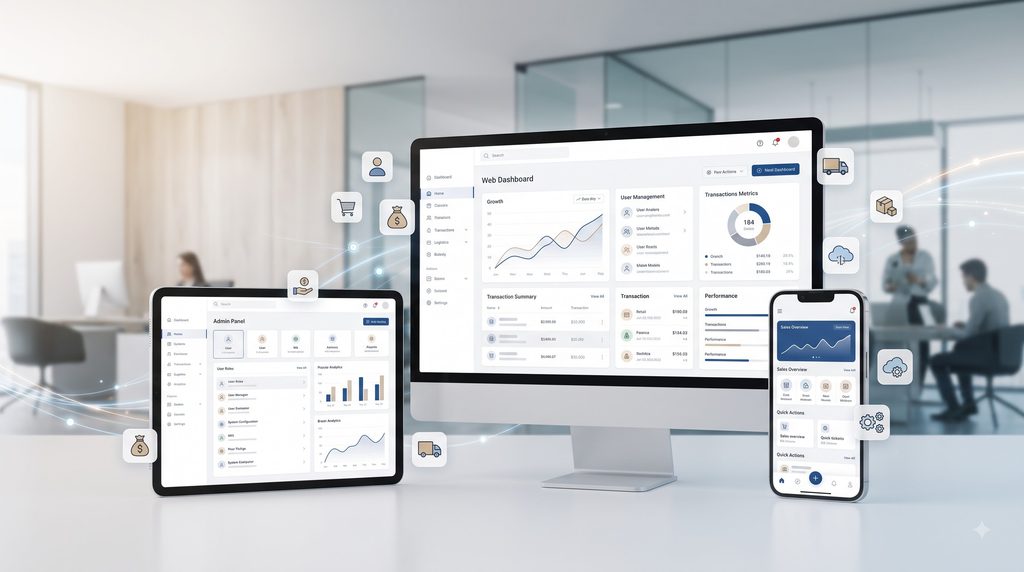
B2B businesses are seeking out White Label Fintech Solutions, which allow businesses to build services under their own brand name without requiring investments in designing and developing a full scale digital platform.
In the context of a White Label Solution, businesses are able to forgo the creation of individualized systems for customers, retailers and distributors; the processing and clearing of transactions; and the provision of various services, if need be.
What Is a B2B White Label Solution?
A B2B white label solution provides an technology solution that a business can operate under its own brand.
The technology provider has the responsibility of managing and operating the underlying platform.
The business is responsible for building a branded experience for its customers and business partners.
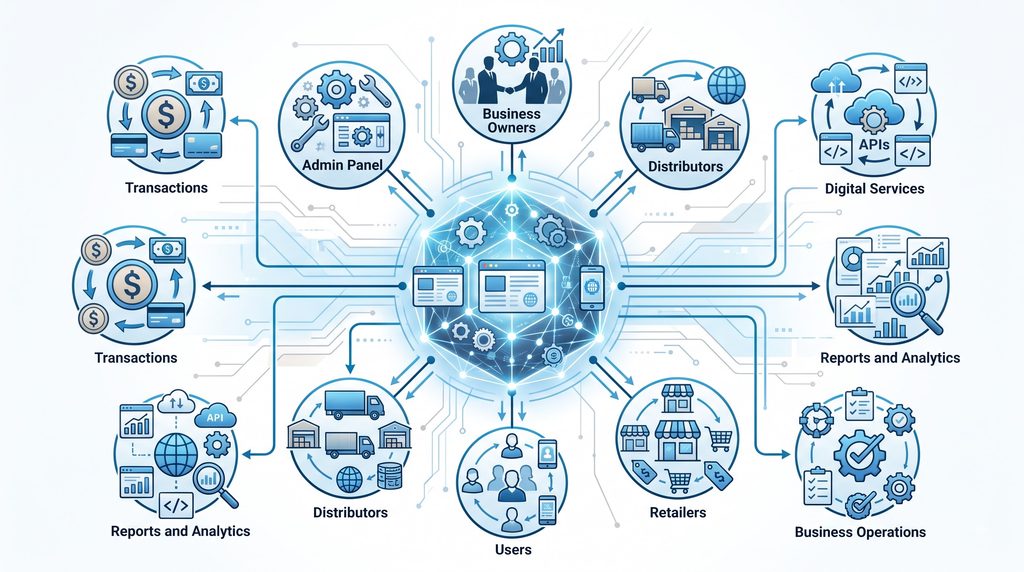
A complete solution may include the following elements:
- A branded website
- A branded mobile application
- An admin panel
- The management of retailers and distributors
- The processing of transactions and the management of a digital wallet
- The management of commissions
- The generation of reports, and
- The integration of various services.
Specifics depend on the partner, the conditions of the market, the functionality supported by the service, and partner/regulatory conditions.
How Does a B2B White Label Solution Work?
A typical implementation starts by understanding the business model.
1. Define Your Business Requirements
The business first identifies its users, services, network structure, and operational requirements.
For example, a company may need a platform for retailers and distributors rather than a direct-to-consumer application.
2. Select Required Services
The business can select the financial, payment, utility, business, or other digital services relevant to its customers.
3. Configure the Platform
The platform is configured around the required workflows, user roles, services, and business rules.
4. Apply Your Brand
The customer-facing experience can be built around the business’s branding and identity.
5. Manage Operations
Administrators can use the backend to manage supported users, services, transactions, commissions, and reports.
Benefits of a B2B White Label Solution
Faster Technology Deployment
Developing a B2B platform in-house can get expensive and time consuming. A white label solution provides a ready-to-go platform.
Build Your Own Brand
The solution allows a company to keep its own brand experience by being able to present the solution under its own company name..
Support Business Networks
B2B businesses work with retailers, distributors, agents and other businesses as their customers and partners. An applicable software can help you manage your business partners.
Centralized Administration
A centralized admin system makes it easier to perform day-to-day tasks by bringing together users, transactions, services, and reports in a single system.
Expand Services
Supported services can be added by a business if their requirements change, as long as certain conditions (technical, partner, eligibility, and regulatory) are met.
Who Can Use a B2B White Label Solution?
A B2B white label solution can be useful for:
· Fintech companies
· Digital service providers
· Distributors
· Super distributors
· Retail networks
· Payment businesses
· Entrepreneurs
· Companies expanding into digital financial services
The most suitable configuration depends on the business model and target users.
Key Features to Consider
Before selecting a B2B white label solution, businesses should evaluate:
Web Platform: A branded web interface for users and business operations.
Mobile Application: Mobile access for supported users and retailers.
Admin Panel: Centralized control over users, services, transactions, and reports.
Retailer Management: Tools for managing retailer accounts and service access.
Distributor Management: Support for businesses operating multi-level distribution networks.
Commission Management: Functionality for managing applicable commission structures.
Transaction Reporting: Reports that help administrators monitor operational activity.
B2B White Label Solution vs. Building From Scratch
Build your own application and you control everything. You also take on the responsibility of architecture, development, integration, testing, maintenance, and more.
White label solutions enable faster time to market at the cost of control and flexibility.
It’s essential to evaluate the company’s financial runway, core competencies, and the level of control and ownership desired when determining the best solution. Long term strategy is critical.
Why Choose IMOC Digital?
IMOC Digital integrates Web and Mobile platforms with an Admin Panel to provide B2B technology solutions.
Its solutions cater to various business models such as retail, wholesale, and e-commerce, and financial services including payment, and other digital services.
The solution can also be tailored to other business and travel related services, as per the requirements of the business and conditions of the service.
Frequently Asked Questions
What is a B2B white label solution?
It is a ready technology solution that a business can operate under its own brand for serving customers, retailers, distributors, or other business users.
Can I customize a B2B white label solution?
Customization depends on the provider and solution. Businesses should confirm branding, workflows, integrations, user roles, and other customization options before implementation.
Who needs a B2B white label solution?
Fintech companies, distributors, retailer networks, payment businesses, digital service providers, and entrepreneurs can use B2B white label technology depending on their business model.
Does a B2B white label solution include an admin panel?
Many B2B solutions include an admin panel. The available administrative features depend on the selected platform.
Conclusion
A B2B White Label Solution helps businesses build their own digital services. Businesses can build administrative and service management applications to create end-to-end B2B digital platforms and services.
Look into the technology partner’s technology, services, and ability to support your business as it grows to determine which partner is the most suitable. Evaluate the partner’s integrations, support, security, and their flexibility to adapt to your business.