
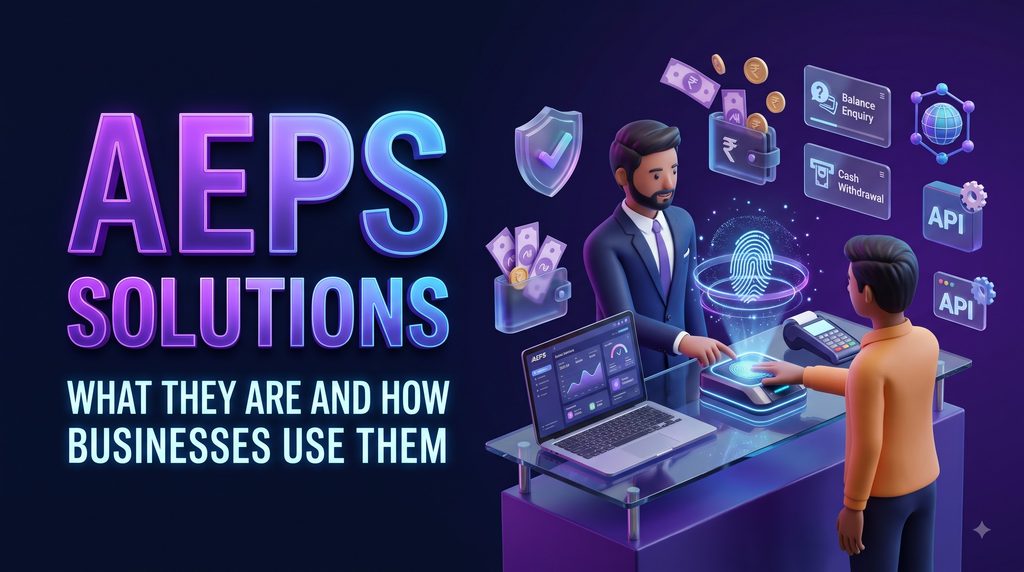
There is still a high demand for banking services to be made available through physical outlets in many parts of India. Using Aadhaar-enabled payment systems (AEPS) in conjunction with banking services can help you provide such services. If you are in the retail, distribution or fintech business, AEPS can provide a valuable service to your customers.
We discuss what AEPS is, how an AEPS transaction happens, and the three main ways in which a business can provide AEPS to its customers. This guide is written for business people and not for engineers. We also provide a practical checklist for assessing an AEPS solution provider.
What Is AEPS?
AEPS, or Aadhaar Enabled Payment System, is a model developed by the National Payments Corporation of India (NPCI) for facilitating banking services to Aadhaar-linked bank account holders, through pre-authorized service points, using Aadhaar-based authentication.
Authentications for different services may require a biometric input using a fingerprint scanner, for instance. The Aadhaar Enabled Payment System is used through supported micro-ATMs, kiosks and other service-point set-ups.
The names AEPS and AePS refer to the same payment system.
The key aim of AEPS is to reach banking services to customers, primarily those who do not have a bank branch or ATM in their vicinity. An eligible retailer can act as a local banking service point, with the support of an appropriate bank or service provider.
To read about AEPS in detail, kindly refer to the NPCI AePS Product Booklet.
How an AEPS Transaction Works
An AEPS transaction may seem simple to the customer, but there are several procedures that happen behind the scenes. Here is the general overview of the process.
What the Customer Does
The customer goes to an AEPS enabled service point and requests for a banking service of their choice that is made available. Depending on the workflow supported, the customer provides their Aadhaar information or other allowed identifiers and completes the authentication using a biometric device approved by the service.
The customer confirms the requested transaction through a process applicable to that transaction. Differing from a conventional card-based transaction, AEPS makes use of Aadhaar-based authentication as opposed to swiping a debit card.
What the Retailer Does
The retailer opens the AEPS service using an approved platform or application. They select the service, enters required transaction details and helps the customer complete the process.
The status of the request is shown after it is submitted. The retailer should first confirm the outcome with the system before informing the customer that the transaction has been successfully completed.
What happens Behind the Scenes
The request for the transaction is forwarded through the corresponding banking and service provider infrastructure. Aadhaar authentication is processed through the corresponding authentication system and the concerned bank and transaction participants process the request as per the supported workflow.
The outcome is returned to the retailer’s platform and the status of the transaction can be ascertained.
NPCI operates the relevant interbank payment infrastructure and UIDAI operates the Aadhaar authentication framework.
An ideal platform also keeps a record of transactions and helps to generate management reports to help businesses audit and monitor their activities, investigate pending or failed transactions and solve reconciliation issues.
Common AEPS Services
The services enabled by AEPS depend on the participating bank, provider and transaction setup and applicable rules. Below mentioned services are generally associated with AEPS:
- Balance enquiry: Check your balance through a supported transaction.
- Cash withdrawal: Withdraw cash through an authorized service point.
- Cash deposit: Deposit cash through an authorized service point.
- Aadhaar-to-Aadhaar fund transfer: Transfer money to beneficiary’s Aadhaar linked account, through a supported service and transaction.
- Mini statement: View recent account transactions through a supported service.
Not all banks and providers offer all the services through all transaction setups. Transactions limits, charges, eligibility and availability may vary. Consult latest NPCI guidelines and relevant bank/provider framework, before communicating/publicizing a service to your customers.
Who Uses AEPS Solutions?
AEPS solutions work well with businesses that have a retail, distribution or assisted-service network to serve their customers.
- Retailers and shop owners: Integrate supported banking services to your existing retail services.
- Distributors and super distributors: Manage your retailer networks and extend services offered to your partners.
- Fintech companies: Extend your digital financial services to the banking services.
- Digital service providers: Extend your digital services and avoid developing different digital services on your own.
Combine AEPS with other value added services like micro ATMs, and mobile-based domestic money transfer services, based on your business model and the service provider.
Benefits and Challenges of Offering AEPS
Learning about AEPS’ benefits and operation can help you make an informed decision before incorporating it to your business.
Benefits
- Extended service catalog: Business can now extend their service catalog to include banking related services.
- Better serve customers: Retailers can now help customers that are eligible to access banking services.
- Improved operational visibility: AEPS offers a transparent system that allows retailers view their transaction history and other reports.
- Expand business: AEPS can also help retailers extend their business and offer additional digital services.
Challenges
- Eligibility and onboarding: Not all banks, service providers and regulatory bodies have the same requirements.
- Data security and protection: Biometric data should be protected at all times.
- Failed, pending and disputed transactions: There should be clear procedures and policies in place on how to handle failed transactions.
- Customer support: Retailers need to know the reason why a transaction was not completed and what to do if the service is unavailable.
Understanding these factors can help retailers pick an AEPS solution that meets their business needs.
Three Ways to Offer AEPS
The best option for you will depend on your technical resources, budget and the level of control you wish to exercise and the requirements for launching the service.
1. Develop Your Own AEPS Platform
You will want to consider this option if you have the resources to support and integrate a secure payment platform and wish to exercise full control of the design of the platform.
This option is likely to be practical for larger, more advanced organizations.
2. Use an AEPS API
Using an AEPS API will enable your software or application to connect your customers to a third party’s AEPS service.
You will need to integrate your customer’s user experience with the provider’s supported transaction workflows, and design your application to integrate the provider’s transaction services.
This may be a practical option for a fintech organization that wants more control over its software or application.
Prior to engaging an API provider, you should examine the integration documentation, the provider’s supported methods of authentication, reporting, transaction-status handling and the available support and terms.
3. Select a White Label AEPS Service
With a white label solution, a service provider gives you the ability to provide your customers an AEPS platform, through your brand, based on the features supported by the service provider.
Package features may include: web platform, mobile application, admin panel, management of retailers and distributors, workflows and reports on transactions.
With this approach, the need to create an end to end platform may be eliminated. Branding, level of customization, integration and available options may depend on the provider.
A white label option may work for a business that wants to launch a digital services branded platform and not manage the entire development process internally.
Find out more about IMOC Digital’s AEPS service and its white label options.
AEPS Solution Options Compared
| Comparison | Build Your Own | AEPS API | White Label |
| Who builds the platform? | Your team | Your team integrates the provider’s service | Provider supplies the platform |
| Technical effort | High | Medium, depending on integration scope | Generally lower for the initial platform |
| Control over design | High | High over your own application experience | Depends on provider customisation |
| Best suited for | Businesses with strong technical teams | Businesses with developers and an existing platform | Businesses seeking a ready-made branded platform |
| Main consideration | Development, maintenance and integration responsibilities | API documentation, integration and ongoing support | Features, branding, pricing and provider dependencies |
The exact scope, cost and responsibilities of each option depend on your requirements and the provider’s terms. Confirm these details before making a decision.
How to Choose the Right AEPS Solution
Choosing a provider is an important step, since your business platform must support reliable operations, appropriate security controls and adequate resolution of issues.
Use this checklist to assess AEPS solution provider offerings.
1. Scope of Services
Find out which services and features of the platform are offered and which are not. Understand your responsibilities, the provider’s responsibilities and the banking or service partners’ responsibilities.
2. Compliance and Eligibility
Find out the eligibility conditions and what documentation and compliance responsibilities are required of your business and the provider.
3. Security and Data Protection
Understand how Aadhaar data is handled, what type of biometric authentication is done and what security controls are in place to protect the platform and the data.
Prior to going live, check that required data privacy, retention, access controls, and security controls are in place.
4. Transaction Reporting
Check if the platform provides a facility for reporting and transaction history, transaction status and reconciliation.
How should your team navigate failing or stuck transactions? What data do you have for operational monitoring?
5. Technical and Customer Support
How are issues reported? Who do you contact for transaction-related issues? What support is available?
If you manage a large retailer network, how will your team and retailers be able to access help when needed?
6. Transparent Pricing and Written Terms
What are the written terms for transaction-related costs?
What are the commercial terms, scope of support and responsibilities before signing the agreement?
7. A Practical Demonstration
Request a demonstration of the actual platform or integration workflow. What user journeys should be covered? What transactions or statuses should be covered? Check the reporting and administrative features.
What are the eligibility requirements or service limitations for the guarantee? Are there any provisions or things that the service will not cover?
Compliance and Safety Basics
Security and the proper functioning of operations are especially important for AEPS because financial transactions are involved, and authentication is based on Aadhaar.
Businesses must:
- Use the authorized service and the prescribed authentication arrangements.
- Handle Aadhaar-related data as prescribed by law and regulations.
- Follow the prescribed authentication process and consent requirements.
- Avoid the collection and retention of sensitive data as far as possible.
- Restrict access to sensitive data to authorized personnel.
- Implement appropriate processes and procedures for failed transactions, customer complaints and record keeping.
- Follow the guidelines of UIDAI, NPCI, applicable banks and regulators.
Be aware that there may be changes to the terms of availability of services because of regulatory, banking, partner or other reasons, including limits on the types of transactions supported.
Assume that not all service providers offer all the AEPS services, and not all AEPS transactions will be offered with the same arrangement.
Confirm the requirements before providing a service to ensure you are compliant with the law.
For specific legal or compliance issues for your own business, consult a qualified professional.
AEPS Solutions with IMOC Digital
IMOffC Digital Services Private Limited (formerly IMOC Digital Services Private Limited) offers technology and digital services for businesses to create digital service platforms for their businesses.
A digital service platform may include web and mobile applications along with an admin panel. Moreover, it may include functionalities for retailer and distributor management, wallet and transaction, commission and report generation, and operational monitoring.
The wider retail business ecosystem of IMOC Digital Services is said to be associated with a reported network of more than 10 Lakh retailers. IMOC Digital Services has more than 8 years of industry and business experience. These facts should be corroborated by the latest company documents before publication.
Depending on the service and partner configuration, AEPS may be offered as part of a digital services bundle.
In the context of offered digital services, AEPS, may involve services of a bank or another service provider, and integration with various channels and payment devices, subject to agreement with IMOC Digital. Details such as availability of APIs, technical documentation, pricing, services, and banks covered, may be confirmed with IMOC Digital.
Please visit IMOC Digital Services AEPS offering to know more.
AEPS FAQs
What Is the Full Form of AEPS?
AEPS stands for Aadhaar Enabled Payment System. The name is also commonly written as AePS.
Who Developed AEPS?
The National Payments Corporation of India (NPCI) developed AEPS as a bank-led model for Aadhaar-enabled banking services.
Does a Customer Need a Debit Card for AEPS?
AEPS uses Aadhaar-based authentication rather than a conventional debit-card swipe. The exact identification and authentication steps depend on the supported service and transaction process.
Which Transactions Can Be Done Through AEPS?
Commonly associated services include balance enquiry and cash withdrawal. Cash deposit, fund transfer and mini statement facilities depend on the participating bank, provider arrangement and current service availability.
Confirm the supported services before promising them to customers.
Can Any Business Offer AEPS?
Not automatically. Eligibility, onboarding, documentation and operating requirements depend on the relevant bank, service provider and applicable rules. Contact a suitable provider to understand the requirements for your business.
Should I Choose a White Label AEPS Solution or an API?
An API may be suitable if your business has developers and wants to integrate a supported AEPS service into its own application or platform.
A white label solution may be suitable if you want a ready-made platform under your brand without developing the entire system internally.
Compare technical requirements, available features, pricing, support and customisation before deciding.
You can also explore IMOC Digital’s AEPS service to discuss the available integration and platform options.
Talk to Us About AEPS
Looking to add AEPS to your fintech platform or retailer network?
Tell us about your business model, expected network size and whether you need an API integration or a complete white label platform.
Discuss your AEPS requirements with IMOC Digital to understand the available options, applicable service scope and next steps.
About the Author
Mohd Akram is a fintech and digital business enthusiast who writes about financial technology, digital banking solutions, and business automation. He focuses on simplifying complex fintech concepts such as AEPS, API integration, and white label solutions to help businesses, retailers, and entrepreneurs understand technology-driven opportunities and make informed business decisions.